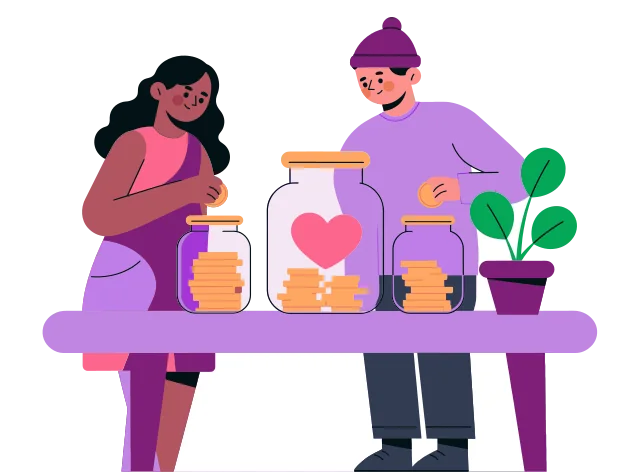
Saver, meet spender: when you handle money differently
Opposites often attract, especially with money. How to handle different spending styles without one of you becoming the bad guy.

The short version
Money
- Different money styles are common, and they usually come from different histories and values.
- Treat it as a lasting difference to manage, not a flaw to fix.
- Agree some shared rules and give each of you room: a savings goal, and some no-questions-asked money.
One of you checks the banking app every day and feels a little pang at every coffee. The other thinks life's too short not to get the nice wine. You've had the conversation many times. You'll probably have it again.
That's OK. Here's how to make it a better conversation.
You're far from unusual. In a study by Scott Rick, Deborah Small and Eli Finkel, tightwads and spendthrifts tended to marry each other. Bigger differences went with more arguments about money, and those arguments went with lower satisfaction. Which is exactly why it's worth handling well.
It's a difference, not a defect

Saver versus spender is a classic lasting difference, rooted in personality and history. It isn't going away, and that's fine. The goal is to understand it and build a way of living with it.
When a difference keeps coming back, take turns explaining what your side means to you, without trying to persuade, while the other asks questions like a curious friend. What does this mean to you? Is there a story behind it? Only once you both feel understood do you move on to a compromise.
What each style is protecting
The saver
Safety and calm
Often grew up with money worries, or values knowing there's a cushion. Spending can feel risky.
The spender
Joy and generosity
Often values experiences, treating people and enjoying now. Too many rules can feel like a cage.
Both are good things. A saver keeps you safe. A spender makes sure you actually enjoy the life you're saving for. Most couples need a bit of both.
Instead of
You're so tight. It's embarrassing.
Try
I know saving helps you feel safe, and I want that for you. I also want us to enjoy some of it now. Can we find a split that does both?
Find your core and your flex
A simple trick works well here. Each of you writes two lists: the small core you can't give up, and the things you could flex on.
Saver's core
Three months of costs always in savings
Could flex on: how fast we get there, what counts as essential, the holiday budget.
Spender's core
One proper holiday a year
Could flex on: where we go, how long for, how we save for it.
Then look for a deal that protects both cores. It's usually more possible than it felt mid-argument.
Ideas that work for a lot of couples
A few compromise shapes that help when you're stuck:

- Part of each. Some of every month goes to savings, some to fun. Agree the split once, then stop debating each purchase.
- My way, your way. Each of you gets a personal spending amount, no questions asked.
- A trial. Try a rule for three months, then review it on a money date.
- A threshold. Anything over an agreed amount gets a quick chat first. Anything under it, no need.
For the practical side of setting up accounts, see joint, separate or a bit of both.
Sources and further reading
- Rick, S. I., Small, D. A., & Finkel, E. J. (2011). Fatal (fiscal) attraction: Spendthrifts and tightwads in marriage. Journal of Marketing Research, 48(2), 228–237.
We describe these studies in our own words, and we're not affiliated with their authors. This article is general information, not therapy or professional advice.