When work follows you home
A bad day at work has a way of landing on the person you love most. How to back each other through work stress without it spilling into the relationship.
The short version
Home & work
- Stress from work spills into home life for almost everyone. Noticing it is half the battle.
- Ask what kind of support your partner wants: a listener, a plan, or some space first.
- Celebrating good news matters as much as helping with bad news.
You get home after a rough day. Your partner asks a perfectly normal question about dinner, and you snap. Two minutes later you're arguing about something neither of you cares about.
Sound familiar? Work stress has a way of following us through the front door. The good news is that couples can learn to handle it together, and get closer in the process.
Stress plus a thought equals a snap
Anger usually needs two ingredients: a stress (tired, hungry, worried, hurting) and a trigger thought (“they don't care”, “it's not fair”, “after everything I do”). A long day supplies the first. A small thing at home supplies the second. When you notice yourself getting sharp, ask: what else is weighing on me today?

That one question changes a lot. It turns “you're so annoying” into “I'm wiped out and I'm taking it out on you”, which is far easier to fix.
Some people go quiet, and that's OK
In a well-known study, psychologist Rena Repetti followed air traffic controllers and their wives. After heavier shifts, the controllers were more withdrawn at home, and showed less anger too, especially on evenings when their wives were very supportive. Repetti suggested that pulling back for a while may help people recover, and a supportive partner gives them room to do it.
So if your partner needs twenty quiet minutes before they can chat, it may not be about you. And if you're the one who needs quiet, say so, so it doesn't feel like a cold shoulder: “I've had a horrible day. Give me half an hour and I'm all yours.”
Ask what kind of support they want
When your partner's had a bad day, the urge to fix it is strong. Sometimes that's exactly what they want. Often it isn't.
Listen
“Do you want to vent?”
No advice and no silver linings. Just interested questions and “that sounds awful”.
Help
“Want to think it through?”
Practical ideas, once they've had a chance to say how it felt.
Space
“Want some time first?”
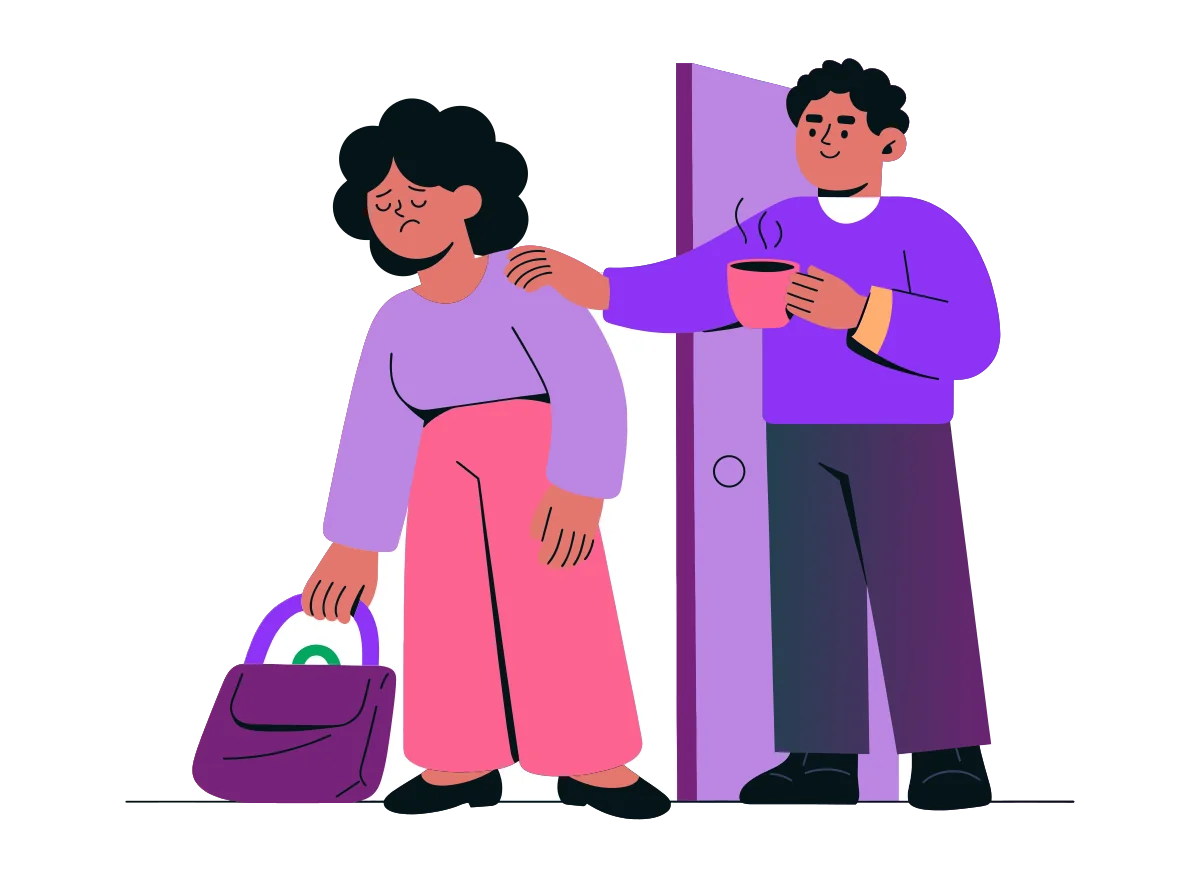
A cup of tea, a quiet room, and a hug later.
The best support is there when it's needed, doesn't take over, and cheers your partner on. Listen to the work worries without trying to manage them.
Instead of
Well, you should just tell your boss where to go.
Try
That sounds exhausting. Do you want to talk it through, or would you rather switch off for a bit?
Don't forget the good days

Supporting each other isn't only about bad news. Research by Shelly Gable and colleagues found that how a partner responds to good news matters too. People who felt their partner reacted to their wins with real enthusiasm (“That's brilliant, tell me everything!”) tended to feel happier in their relationship. Flat or distracted replies (“Nice. What's for tea?”) didn't have the same effect.
Little ways to leave work at work
- A changeover ritual. Get changed, take a short walk, or sit in the car for one song before you go in.
- A five-minute download. Each of you gets five minutes to talk about your day while the other just listens. Then it's done.
- A work-free zone. Dinner, the bedroom, or after 9pm: whatever works for you.
- Name the overflow. “Work's been heavy this month. If I'm short with you, it's that, not you.”
For more on those first moments after work, see the first five minutes.
Sources and further reading
- Repetti, R. L. (1989). Effects of daily workload on subsequent behavior during marital interaction: The roles of social withdrawal and spouse support. Journal of Personality and Social Psychology, 57(4), 651–659.
- Gable, S. L., Reis, H. T., Impett, E. A., & Asher, E. R. (2004). What do you do when things go right? The intrapersonal and interpersonal benefits of sharing positive events. Journal of Personality and Social Psychology, 87(2), 228–245.
We describe these studies in our own words, and we're not affiliated with their authors. This article is general information, not therapy or professional advice.