Press pause: how to take a break mid-argument
When your heart's racing, nobody can listen. How to take a break that calms things down, instead of one that feels like walking out.
The short version
Conflict
- When you're overwhelmed, your body goes into fight-or-flight and listening gets almost impossible. A break isn't giving up. It's how you get back to a good conversation.
- Say you need a break, say when you'll be back, and keep your word.
- Use the time to calm down, not to rehearse your case. Aim for at least 20 minutes and no more than a day.
You know the moment. Voices are getting louder, or one of you has gone very quiet. Everything you say comes out wrong. You're not really talking any more, just reacting.
That's the moment for a break. Done well, it's one of the most useful things a couple can learn.
Why you can't think straight
The Gottmans call it flooding: your body decides you're under threat. Your heart speeds up, your breathing gets shallow, your face feels hot and your thinking narrows. Brilliant for running from a bear. Terrible for hearing your partner's point of view.
100+
beats per minute is roughly where the Gottmans found people start to flood. Past that point, listening and creative thinking drop away.
Julie Schwartz Gottman and John Gottman, Fight Right (2024)
Signs to watch for:
- Your heart's pounding or your chest feels tight.
- You feel hot, shaky or suddenly exhausted.
- You can't remember what your partner just said.
- You want to shout, or you want to leave.
- Your messages are getting faster and shorter.
How to call a break well
A break works when it feels like a pause, not a door slam. The difference is almost entirely in how you say it.
Instead of
I can't do this. I'm out.
Try
I'm getting too wound up to listen properly. Can we take half an hour? I'll come and find you at eight.
A few rules that help, from Fight Right and Couple Skills:
- Talk about yourself, not them. Say “I need a break”, never “you need to calm down”. Telling someone they're overwhelmed almost always makes it worse.
- No last word. Skip the parting shot. It'll be the thing they think about for the next hour.
- Give a time. The person left behind needs to know you're coming back. Without a time, a break can feel like being abandoned.
- Agree a signal in advance. A word, a phrase, even a hand sign. Agreed while you're calm, it's much easier to use when you're not.
What to do with the time
This is where most breaks go wrong. If you spend twenty minutes replaying the argument and polishing your best lines, you'll come back angrier than you left.
- 1
Go somewhere else
Another room, the garden, a walk round the block. Out of sight helps.
- 2
Do something absorbing
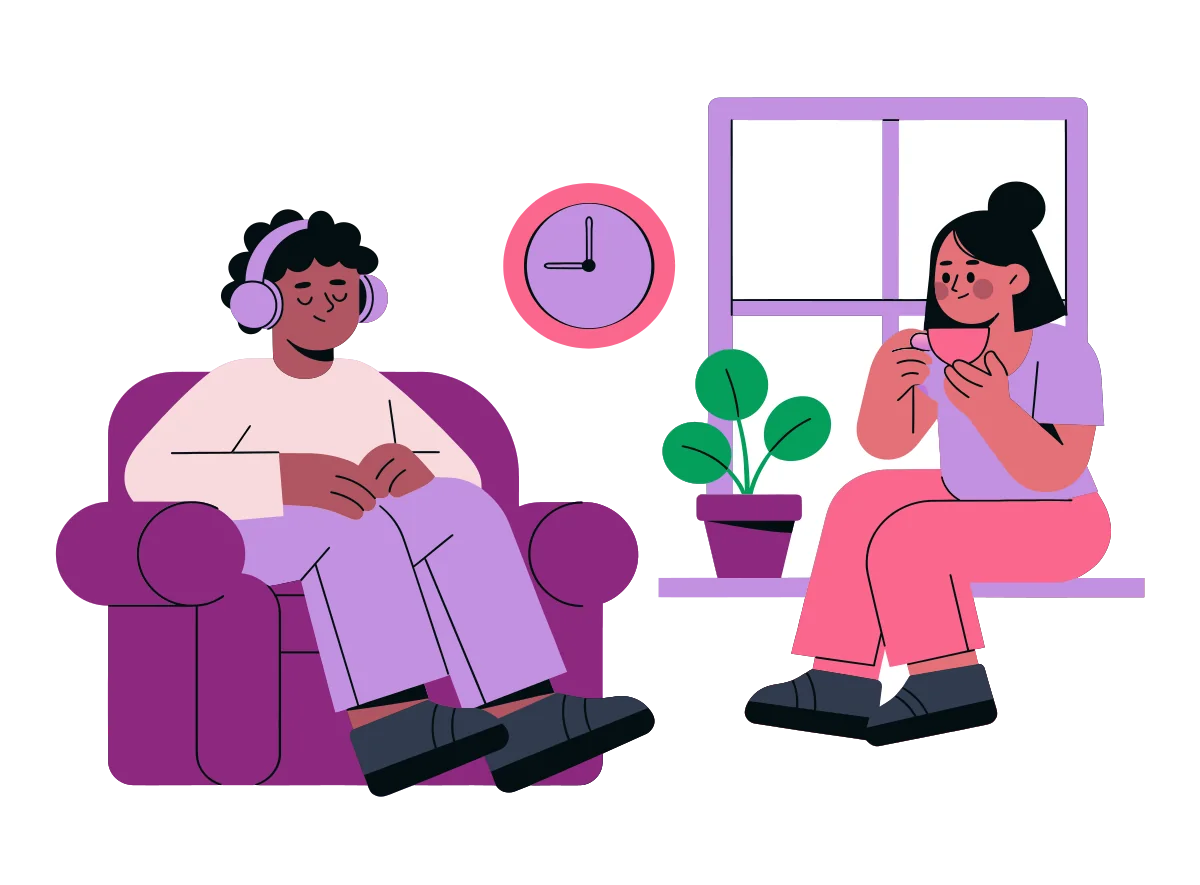
Music, a podcast, a shower, a puzzle, a chore. Something that fills your head.
- 3
Breathe slowly
Long, slow breaths out. Loosen your jaw and drop your shoulders.
- 4
Don't vent to friends yet
Couple Skills points to research suggesting that venting keeps anger going rather than letting it out.
- 5
Come back when you said
Even if you're not ready. Come back and say “I need a bit longer. Can we say nine?”
Coming back
The Gottmans suggest at least 20 minutes, because that's roughly how long your body takes to settle, and no more than 24 hours, because after that a break starts to feel like a punishment. Most people need about an hour. It's fine to sleep on it.
When you come back, start softly. Couple Skills suggests opening with something like: “I think I was partly right and partly wrong. The bit I'd take back is…”. Then pick up where you left off, or make up properly if things got hurtful.
Sources and further reading
- Julie Schwartz Gottman and John Gottman, Fight Right: How Successful Couples Turn Conflict into Connection (Harmony Books, 2024).
- Matthew McKay, Patrick Fanning and Kim Paleg, Couple Skills: Making Your Relationship Work (2nd edition) (New Harbinger, 2006).
- Amir Levine and Rachel Heller, Attached: The New Science of Adult Attachment (TarcherPerigee, 2010).
We describe these books in our own words, and we're not affiliated with their authors. This article is general information, not therapy or professional advice.